
Blog
Steel tube bending
Precise & elegant solutions for furniture & shopfitting
LMV BLOG – Lauingen 01.10.2025
Bent steel tubes are indispensable in furniture and shopfitting. They combine design with functionality and create durable, stable constructions. To ensure that the results meet the highest standards, precise planning, modern CNC technology and many years of experience are crucial.
1. Key Facts at a Glance
-
Precision in bending: CNC technology enables exact shapes, consistent radii and highest repetition accuracy, ideal for furniture and shop fitting.
-
Material wall thickness: The right choice of material and control of the wall thickness prevent deformation, cracks and loss of quality.
-
Bending processes as required: Mandrel bending for tight radii, freeform bending for flexible geometries, CNC bending for series production and complex shapes.
-
Finishing Refinement: Grinding, electroplating, and powder coating ensure durable surfaces that are both functional and visually appealing.
-
Individual or in series: From prototypes to large series, LMV offers economical complete solutions from a single source.
2. What is important when bending steel tubes
The bending of steel tubes is a highly precise manufacturing process where several factors are crucial to ensure quality, stability, and aesthetics.
Consider Material Properties
Different types of steel have different bending behavior. Factors such as wall thickness and elasticity determine how well a tube can be deformed.
Select the Correct Bending Radii
Radii that are too tight can lead to deformation or kinking. Experience and the correct machine setting are crucial to achieve clean results.
Control of the Wall Thickness
To prevent cross-sectional constrictions or material cracks, the appropriate bending technique must be selected. This guarantees dimensional accuracy and stability.
Ensure Series Accuracy
Especially in furniture and shopfitting, identical repetitions are required. Millimeter-precise CNC bending ensures consistently high quality here.
Post-processing Finishing
After bending, work steps such as grinding, electroplating, or powder coating follow. This results in steel tubes that are not only functional but also visually appealing.
3. What processes are there for bending steel tubes?
Depending on the requirement, different bending processes are used:
1. Mandrel bending
Here, a mandrel is inserted into the tube to prevent kinking or ovalization. This method is particularly suitable for tight radii and thin-walled tubes, as are often found in furniture construction.
2. Freeform bending
In this process, the tube is bent without a mandrel. It is suitable for larger radii and complex geometries when flexibility in shaping is required.
3. CNC Tube Bending
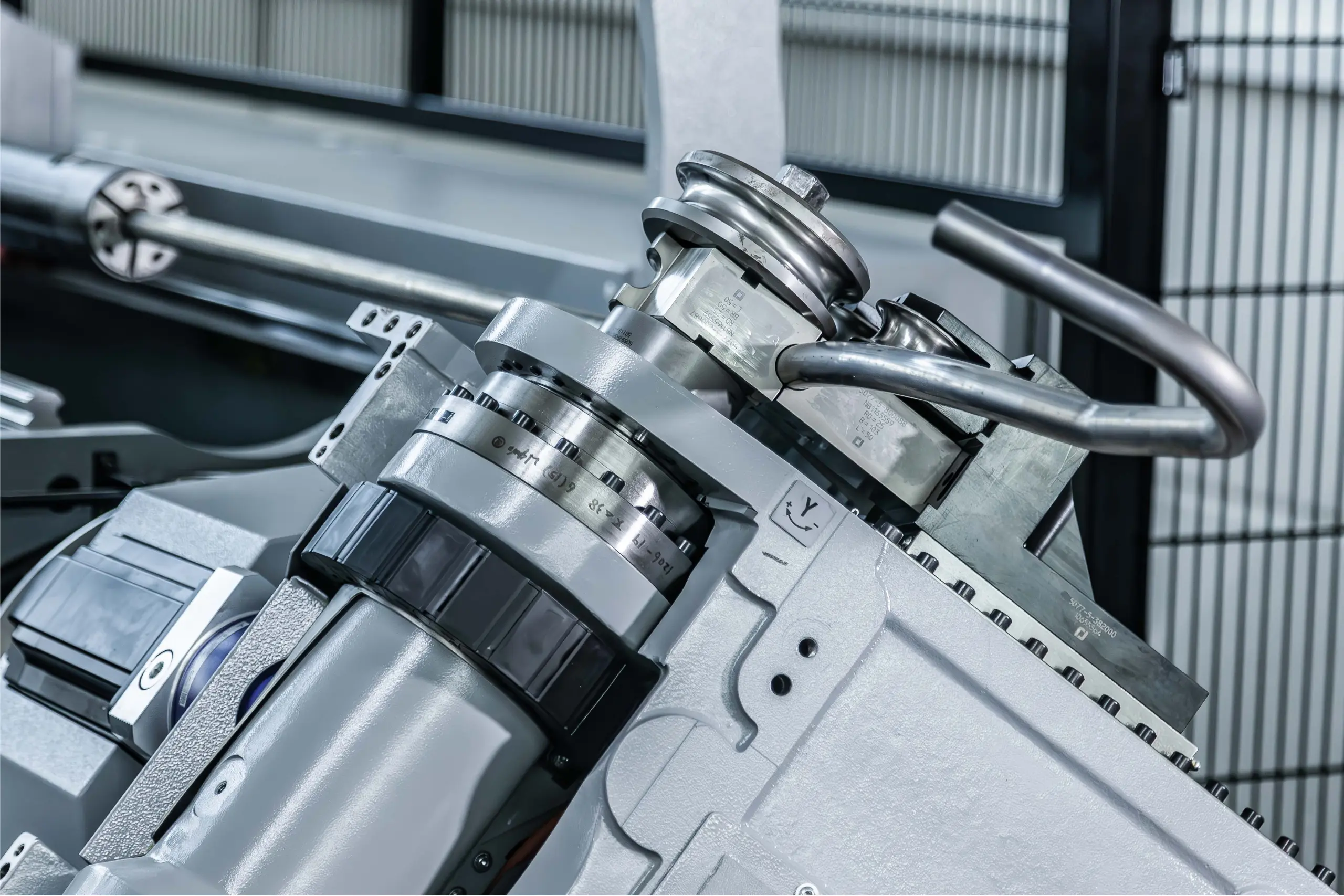
Modern CNC bending machines enable the precise control of angles and radii. The process is ideal for series production and ensures maximum repeatability; at LMV, it is standard.
The choice of the right process depends on the material, the tube diameter, the wall thickness and the requirements of the project.
4. Sequence of the bending process at LMV
Step 1: Planning Design
Using CAD systems, we develop customized solutions that precisely meet the requirements of our customers.
Step 2: Material Selection Preparation
Depending on the area of application (e.g. furniture frames or shopfitting elements), the appropriate steel tube with optimum wall thickness is selected.
Step 3: CNC Bending
Our computer-controlled machines implement the bends precisely – even with complex shapes and different radii.
Step 4: Quality Control
Each bending process is checked to ensure dimensional accuracy and surface quality.
Step 5: Finishing further Processing
In-house electroplating, powder coating, and welding technology result in durable, aesthetically pleasing products with a perfect finish.
5. Cost factors in steel tube bending
The costs for bending steel tubes vary depending on the project. Important factors are:
- Complexity of the bend (number and radii of the bends)
- Diameter wall thickness of the tube
- Type of material (different types of steel have different bending behavior)
- Quantity (individual items vs. large series)
- Post-processing finishing (e.g. electroplating, powder coating)
- Tolerances quality requirements
Thanks to our optimized machinery and in-house finishing, LMV can offer particularly economical complete solutions.
Request a non-binding consultation.
6. Practical example: Furniture construction with steel tubes
LMV manufactured tailor-made chair frames for a customer from the furniture industry. The challenge was to combine a filigree design with high stability. CNC bending, subsequent chrome plating and exact quality control resulted in a frame that is both visually elegant and extremely robust.
The project shows: With the right technology and experience, aesthetic demands and functional requirements can be perfectly combined.
7. Further areas of application for bent steel tubes
In addition to furniture and shopfitting, bent steel tubes are also used in many other industries:
- Mechanical and plant engineering – stable construction elements
- Architecture interior design – stair railings, handrails, design elements
- Transport automotive – frames and support structures
- Medical technology – robust and hygienic frames or devices
This variety shows: Steel tubes are a universal material that can be used in a wide variety of industries through precise bending.
8. LMV Metalltechnik - Your partner for bending technology metal processing
Since 1975, LMV Metalltechnik has been offering solutions for all aspects of metal processing and finishing. With over 75 employees, state-of-the-art machinery, and a production area of 16,000 m², we combine tradition, precision, and innovation.
Especially in the field of steel tube bending, we are a partner for furniture manufacturers, shopfitters and industrial companies who value the highest quality. Thanks to our DIN-ISO 9001 certification, customers can rely on consistently tested and documented processes.
If you want to have steel tubes bent, LMV is the partner for you, bringing technology, experience and design expertise into harmony.
9. Why CNC steel tube bending is worthwhile
Advantage: Precision in Every Shape
Thanks to modern CNC technology, steel tubes can be bent with millimeter precision – even with tight radii and complex geometries.
Advantage: Design Meets Functionality
Bent tubes impress not only with their stability, but also with their aesthetic shapes – ideal for furniture, shopfitting and interior solutions.
Advantage: Efficiency in Series Production
Thanks to maximum repeat accuracy, CNC bending is particularly economical and reliable, regardless of whether for small series or large quantities.
Advantage: Gentle on Materials Durable
Optimized processes prevent kinks, cracks or cross-sectional constrictions and ensure the quality of the end product.
Advantage: Everything from a Single Source
At LMV, customers receive complete solutions: from CNC bending and welding to electroplating and powder coating – for perfect results from a single production source.

10. FAQ about pipe bending
10.1 Which steel tubes are best suited for bending?
Particularly cold-formable steels with a uniform wall thickness are suitable. The material is specifically selected depending on the intended use.
10.2 How tight can steel tubes be bent?
The minimum bending radii depend on the tube diameter and wall thickness. Even tight radii can be achieved with modern CNC technology
10.3 What does it cost to bend steel tubes?
The costs depend on factors such as tube diameter, complexity of the bend and quantity. Series productions are generally particularly economical.
10.4 Does LMV also offer small series or individual pieces?
Yes, we manufacture both prototypes and large series with consistently high quality.
10.5 Which surfaces are available?
Thanks to our in-house electroplating and powder coating, numerous variants are possible. From chrome to powder coatings to special surfaces.